

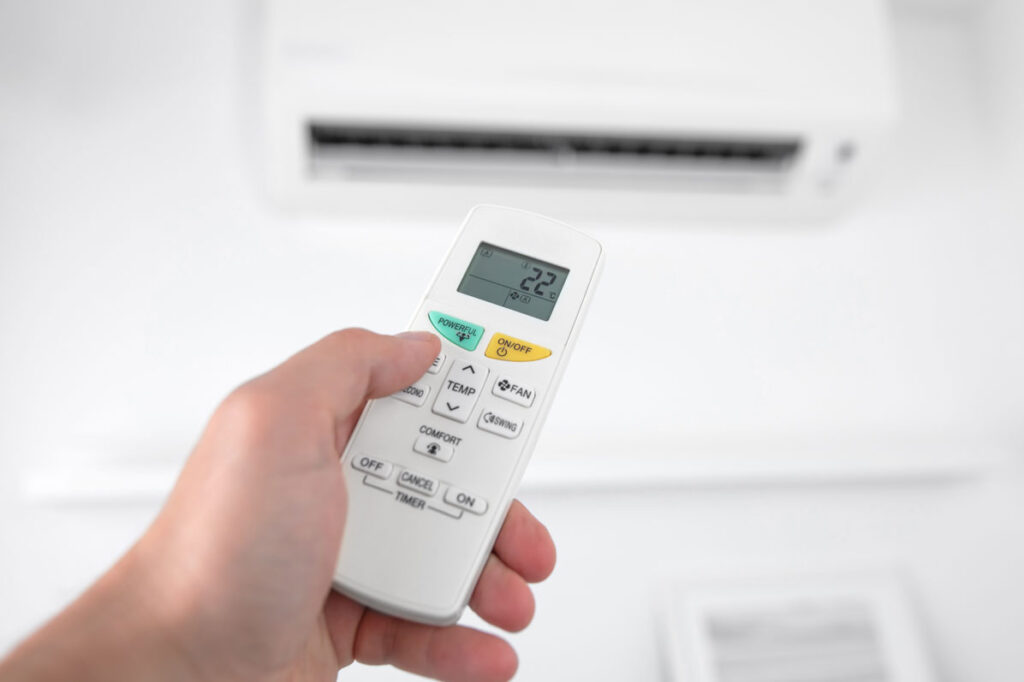
The electricity consumption of an air conditioner depends on factors such as its capacity, usage duration, the number of rooms, and the desired temperature. On average, air conditioners use between 0.5 kWh and 2.5 kWh per hour when cooling. When heating, consumption typically ranges from 0.5 kWh to 3.0 kWh per hour. In this article, we explain which factors affect your air conditioner’s energy use and how you can reduce it.
How does an air conditioner work?
An air conditioner works like a refrigerator, using the evaporation and condensation of a refrigerant. The system circulates the refrigerant, absorbing heat from the room and transferring it outside. This process keeps the indoor air consistently cool, maintaining a comfortable climate.
The refrigerant flows to the outdoor unit, where it releases the absorbed heat. This continuous cycle of heat extraction and release effectively regulates the room temperature, ensuring a cool and comfortable environment regardless of the outside temperature.
How much power does an air conditioner use?
Air conditioning energy consumption can be significant in both summer and winter. At maximum cooling or heating settings, an air conditioner can use up to 5 kWh per hour. In practice, consumption is usually lower. For example, a split-system air conditioner on a normal setting typically uses around 1 kWh per hour per indoor or outdoor unit. For comparison, a washing machine uses roughly 1 kWh per wash.
Annual cost of average consumption
If you use your air conditioner 6 hours per day for 40 summer days, annual consumption is approximately 240 kWh. At the average dynamic electricity rate in 2025 of €0.26 per kWh, this results in cooling costs of around €63 per year.
In winter, many people use their air conditioners for heating. Using the unit 4 hours per day over 90 cold days consumes roughly 360 kWh per year, costing about €94. Combined, this means an air conditioner could cost approximately €157 per year in electricity, depending on usage and electricity rates.
How much capacity do you need?
The larger the space, the higher the required air conditioner capacity:
- Up to 90 m³: up to 2.5 kW
- Up to 120 m³: up to 3.5 kW
- Up to 180 m³: up to 5 kW
- Up to 210 m³: up to 7 kW
Does an air conditioner consume power on standby?
Most air conditioners consume 0.5–1 kWh in standby mode to:
- Control system: Keeps settings like temperature and timers active.
- Remote control: Constantly monitors for signals to allow immediate activation.
- Infrared or temperature sensors: Monitors ambient temperature for optimal performance.
Factors that affect energy consumption
Several factors influence an air conditioner’s energy consumption. For example, the larger the room, the more energy is required to cool or heat it. The unit’s efficiency also plays a significant role—an energy-efficient air conditioner uses significantly less power. The temperature setting also has an impact: the lower you cool in summer or the higher you heat in winter, the higher the energy consumption.
In addition, the operating time also matters: the longer the air conditioner is on, the more power it requires. Finally, the type and model of air conditioner, the age of the unit, and the level of maintenance all influence total energy consumption.
7 Tips to reduce energy use
To help you reduce your air conditioning consumption, we’ve compiled 7 tips that can help:
1. Choose an energy-efficient model:
Look for A++ or A+++ rated units, which consume up to 30% less electricity than older or cheaper models. Consider:
- SEER rating: Efficiency in cooling (higher = better).
- SCOP rating: Efficiency in heating (higher = better).
A SEER of 8.5+ and SCOP of 4.0+ corresponds to A+++ efficiency.
2. Place the unit wisely:
Avoid direct sunlight or heat sources and allow sufficient space around the unit for airflow.
3. Clean filters regularly:
Dirty filters block airflow and force the air conditioner to work harder. Clean them every two months or during maintenance.
4. Set a realistic temperature:
Each degree increase in cooling or heating raises electricity use by about 6%. Avoid unnecessarily low summer temperatures.
5. Use the air conditioner only when needed:
Turn it off when leaving the room, or use a timer or smart control.
6. Keep doors and windows closed:
Maintaining indoor temperature reduces the workload on the air conditioner.
7. Regular maintenance:
A well-maintained air conditioner operates more efficiently, lasts longer, and prevents unexpected issues or higher consumption.
Conclusion
An air conditioner ensures a comfortable indoor climate year-round, providing both cooling and heating. Average electricity use ranges from 0.5 to 2.5 kWh per hour when cooling and up to 3.0 kWh when heating, totaling around 600 kWh or €157 per year. Smart use and an energy-efficient model can significantly reduce consumption.