

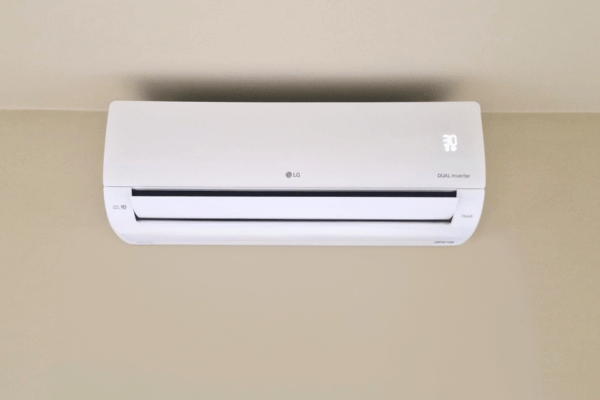
Can an air conditioner be moved? We get that question regularly, often after building work, a house move or a change to the layout of the home. The short answer: in many situations an air conditioner can simply be moved. It is a job for a certified technician, though. The pipework of a split-unit air conditioner contains refrigerant, and for environmental reasons you are not allowed to work on that yourself.
Can I move my split-unit air conditioner myself?
We completely understand the question. From the outside it looks simple: undo a few screws, move the bracket and take the pipework with you. Even so, you are not allowed to work on split-unit air conditioning yourself.
The pipework contains refrigerant, also known as coolant (often R32). If this substance escapes, it does a lot of harm to the environment. Because of the European F-gas Regulation, only a certified technician from an approved company is allowed to work on the refrigerant lines. Doing it yourself is therefore not permitted, and the fines are steep.
On top of that, there is a lot involved technically:
- Safety: A certified technician first recovers the refrigerant properly, so that none of it escapes into the open air.
- No damage: Installing or moving an air conditioner yourself, without the right equipment and experience, makes it very likely that the installation will start leaking or break down.
Why an F-gas specialist and not a handyman?
You may know someone who is handy and happy to take the job on. For a lot of work around the house that is fine, but not for an air conditioner. A handyman or all-round carpenter rarely holds an F-gas certificate and usually does not work for a STEK-certified company. STEK certified means that a company meets the rules for working safely with refrigerants. Without the right certificates, he is not allowed to open the refrigerant lines. If he does it anyway, both the technician and you can be fined.
There is also equipment involved that you cannot just hire somewhere. A vacuum pump to draw the air and moisture out of the refrigerant lines, and nitrogen for the pressure test on the new pipework. A leak test like that reveals hairline cracks you would never spot with the naked eye. An F-gas technician has that equipment and is allowed to recover the refrigerant and release it back into the system.
And if air or moisture is left behind in the system, the compressor can suffer damage from it over time. That is the most expensive part of your air conditioner.
What happens to your warranty?
If you have your air conditioner moved by a company without certification, that can have consequences for your manufacturer’s warranty. Manufacturers set requirements for who works on the installation. So always check the warranty conditions for your own brand before you let anyone start.
We work to the manufacturer’s installation instructions, so you keep your manufacturer’s warranty. On top of that, you get an installation warranty on our own work. If a connection does spring a leak, we come back to put it right. We go through the exact conditions with you beforehand.
Do you need permission or a permit?
Whether you need permission or a permit depends on your home and on where the air conditioner is located.
Do you own your home?
Moving an air conditioner within your own home is usually allowed without permission. For an outdoor unit, however, your local council has rules. An outdoor unit in the back garden is often allowed without a permit. On the front of the building it can be a different story. With an old building or a listed property in particular, extra rules sometimes apply. So always check your local council’s rules first.
Do you live in a flat with a homeowners’ association?
Then you often need permission from the homeowners’ association (VvE) first. The facade and the roof usually belong to all the residents together. That matters especially if you want to move the outdoor unit to the facade, the balcony or the roof.
Permission can be needed for moving an indoor unit too. That depends on the agreements within your VvE. So take a look at the deed of division and the house rules. They set out which changes you are allowed to make in your flat.
Is the VvE saying no to an outdoor unit on the facade, the balcony or the roof? Then an alternative position is often still possible, for example on a private terrace or with a different pipe route. We are happy to think along with you about a solution that does get approved.
So always check first what is allowed for your home, your VvE and your local council. That way you avoid surprises afterwards. We have installed plenty of air conditioners in flats with a VvE and we know what you can run into in practice.
How does moving an air conditioner work?
What actually happens in the house on the day? A lot of customers like to know that in advance. Broadly speaking, the job consists of five steps.
- Pumping down. The technician puts the air conditioner into a special mode. All the refrigerant then flows back to the outdoor unit, where it is safely shut in. We call this pumping down.
- Removal. The refrigerant lines, the electrics and the other connections are disconnected. After that, the technician carefully lifts the indoor or outdoor unit off its bracket.
- Preparing the new spot. We determine the best position, drill the openings and mount the backplate or wall bracket perfectly level. We also look at the condensate drain and the pipe length that will be needed.
- Mounting and connecting. The unit goes into its new place. We run the copper refrigerant lines, the condensate drain and the control cable, and connect everything up.
- Pressure testing, vacuuming and starting up. First we pressure test the pipework with nitrogen, so that any leak shows up straight away. Then the vacuum pump draws out the air and the moisture. Finally we release the refrigerant back into the system and check that the air conditioner cools and heats the way it should.
How long does it take to move an air conditioner?
The time needed depends on the type of air conditioner and on the situation. A straightforward single-split air conditioner is often quicker to move than a multi-split system with several indoor units. The distance to the new spot and the length of the refrigerant lines play a part as well.
As a guide, you can allow for:
| Type of air conditioner / situation | Indicative time |
| Single-split: moving the indoor unit only | ± 2–4 hours |
| Single-split: moving the indoor and outdoor unit | ± 3–5 hours |
| Multi-split: moving several indoor units | ± 5 hours or more |
Please note: a longer pipe route, a different floor or a spot that is hard to reach can take extra time.
Do you need to take a whole day off for this?
For a straightforward move, usually not. Allow for a couple of hours. For a bigger or more complicated job, the technician can be busy for longer.
You can simply stay at home while the work is going on. At the end we tidy everything up neatly, vacuum away the drilling dust and explain how to operate the air conditioner in its new spot.
Is your air conditioner a few years old already? Then this is a good moment to have maintenance carried out at the same time.
Frequently asked questions about moving an air conditioner
Since 1 April 2021 there have been statutory noise limits for the outdoor units of air conditioners and heat pumps at homes. At the property boundary the unit may produce no more than 45 dB(A) during the day, and no more than 40 dB(A) in the evening and at night. That limit is set out in the Dutch Buildings and Environment Decree (Besluit bouwwerken leefomgeving). If you move the outdoor unit, it applies to the new spot as well.
In practice we often solve complaints by putting the unit a few metres further from the property boundary, or by no longer aiming the airflow at the neighbours’ bedroom window. If that does not help enough, we look at anti-vibration mounts or acoustic housing. Not sure whether your set-up meets the limit? We are happy to work that out for you in advance.
That depends on the capacity of your air conditioner and on your fuse box. A light single-split often runs fine on an existing circuit. With a heavier unit or a multi-split, a separate circuit is usually needed. We work that out for you during the survey, so you do not run into it later on.
A fixed air conditioner makes a home more attractive to buyers, certainly if the system heats as well, is neatly installed and is well maintained. It does not add a fixed amount to the value. How much difference it makes varies from home to home, from installation to installation and from neighbourhood to neighbourhood.
Conclusion: have your air conditioner moved by a certified technician
In most situations an air conditioner can be moved without any problem, but it is not a job to take on yourself. The pipework contains refrigerant, and only a certified technician is allowed to work on that. With the right equipment and the right approach, you avoid a leak, damage to the compressor and problems with your manufacturer’s warranty.
Do check in advance what is allowed for your home. If you own a house, that usually means your local council’s rules for the outdoor unit; in a flat, it means permission from the VvE. Once that is sorted, a straightforward move is often done within a couple of hours.
Would you like to know what it costs in your situation? Send us a few photos of the indoor and outdoor unit and of the spot you want to move them to. That is often enough for us to give you a first indication of the price. Call us on 020 782 0041 or request a quote straight away.